
When you are setting up a home theater or connecting new speakers to a power amplifier, the way you connect the speaker cables is a crucial step. At this point, you may need to make a choice between banana plugs and spade connectors.
Banana plugs and spade connectors are the hardware terminations you attach to the ends of your speaker wires, and both types fit standard binding posts and terminate the wires into a clean and repeatable connection. But what differentiates them? The difference is in how they connect, how secure their connection is, and how each type works in the different setups.
In this guide, we’ll discuss what each connector is and how it works, we’ll also compare them from a technical perspective and see which one is better for the different types of installations.
What Are Banana Plugs?
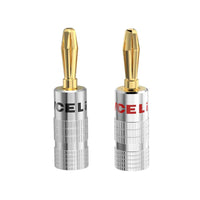
A banana plug is a cylindrical connector that you attach to the end of a speaker wire, a single-pin connector that inserts directly into the socket of a binding post. The “banana” name comes from the small external curve of the spring contacts along its shaft (which puts pressure against the inside wall of the binding post socket and keeps the plug in place through spring tension alone). You don’t need any threading or tightening. And no tools for insertion or removal.
The typical dimension of standard banana plugs is 4 mm. This figure refers to the external diameter of the pin. Most audiovisual (AV) receivers, amplifiers, and speaker binding posts that accept banana plugs are built to this standard, so, a 4mm banana plug will fit the vast majority of consumer and professional audio equipment.
Before reviewing the different types of banana plugs, it’s worth clarifying that the termination methods and their forms or shapes are different and independent criteria. For instance, a right-angled plug can feature any of the terminations described below.
Types of banana plugs depending on their termination methods
- Screw-type plugs. These are the “plug and play” option. They have a small set screw at the back of the plug. To set it up, insert the stripped wire, tighten the screw to clamp it, and rely on the mechanical grip to hold the conductor. These are reusable and relatively forgiving of wire gauge.
- Solder-type plugs. In these models, you need to tin the wire and flow solder into the connector's barrel. As a result, you achieve a low-resistance, permanent bond. These are the usual choice for bench work and permanent installations where the connection will not be moved.
- Toolless or self-crimping banana plugs. Toolless banana plugs use a spring-loaded or cam-action internal clamp that grips the wire when you push or twist the housing closed. They are the most practical for DIY installations when you don’t have a soldering iron.
Types of banana plugs depending on their form or shape
- Standard banana plugs. They are the most common type. The pin goes straight into the binding post socket, and the cable exits straight out the back. If your equipment has open binding posts with enough clearance behind it, this is the one you want.
- Shrouded banana plugs. A plastic sleeve covers the pin and the base of the connector. The sleeve stops the pin from accidentally touching a nearby terminal or metal surface. Worth noting: a shrouded plug fits into a standard socket, but it will not drop into an open binding post collar the way an unshrouded plug does.
- Right-angled banana plugs. The cable exits at 90 degrees to the pin instead of straight back. If your equipment is close to a wall or in a tight rack, a straight plug would force a sharp bend in the cable, right behind the connector. Yet, with a right-angle plug, the cable can run flat along the surface, removing the stress on the jacket and the termination point.
- Dual banana plugs. Dual models have two pins (19mm apart) in one housing. This spacing matches the standard distance between positive and negative binding posts on most consumer audio gear. One push seats both conductors at once, which keeps polarity consistent. A time-saver if you are wiring multiple speakers.
- Stackable banana plugs. They have a 4mm female socket in the back of the housing. You can insert a second banana plug into that socket, so two connections share one binding post without needing an adapter. Common in bi-wire setups and test benches.
- Locking banana plugs. Locking plugs have a threaded collar or twist-lock ring around the pin. After you insert the plug, you rotate the collar to lock it into the socket. This keeps the plug from pulling out under vibration or accidental cable tugs. A good choice for subwoofers, movable racks, or any high-power run where a loose connection would be a real problem.
- BFA plugs. These are used primarily on British-made equipment. Instead of a spring-leaf design, their pin has a slotted profile. Most standard binding posts accept BFA plugs, but BFA-specific sockets do not always accept a standard 4mm pin.
Current ratings vary from one plug to another, so always check the specifications sheet before buying. Most standard 4mm banana plugs handle between 15 and 30 amperes, enough for the large majority of home theaters and hi-fi amplifiers. But if you are running a high-power amplifier that pushes above that range, confirm the manufacturer's rated current before you buy the plugs.
Expert Tip: Before buying banana plugs, confirm whether your binding posts actually have a 4mm female socket. Some entry-level speakers and receivers use a smaller pin or accept bare wire only through a spring-clip terminal that does not accept banana plugs at all.

What Are Spade Connectors?
A spade connector is a forked, flat-lug termination that slides over a binding post shaft and locks under the post's collar or cap when tightened. The two prongs of the fork straddle the post, and tightening the binding post cap clamps the spade firmly against the terminal contact surface. The connection is mechanically locked rather than spring-tensioned.
Types of spade connectors based on insulation and locking systems
1. Insulated spade connectors. Insulated models have a plastic or nylon sleeve over the crimp barrel. The color of the sleeve typically indicates the American Wire Gauge (AWG) range the connector is suitable for:
- Red for 22 to 18 AWG
- Blue for 16 to 14 AWG
- Yellow for 12 to 10 AWG
2. Non-insulated spade connectors. They don’t have a sleeve. They are commonly used in audio applications where the bare metal lug gives a direct metal-to-metal contact at the binding post, which is something some installers prefer for signal-path cleanliness.
3. Heat-shrink insulated spade connectors. These work like the standard insulated spades, but instead of a rigid plastic sleeve, they have a heat-shrink one. After you crimp, you apply heat and the sleeve contracts around the wire entry. It seals it against moisture. A good choice for humid environments.
4. Locking spade connectors. This type of connector has a small barb or retention tab in the fork. After you slide the spade and tighten the cap, the tab engages the post and resists accidental pull-out. Locking spades add a mechanical backup, which is useful in installations where cables are frequently handled or exposed to vibration.
Matching the spade width to the binding post is mandatory. Spade connectors are sized by their fork width, typically 6 mm, 8 mm, or 10 mm. When a spade is too wide, it will not fit under the binding post cap, if it is too narrow, it will fit but may shift laterally under the cap, reducing contact area and, over time, causing instability.
Likewise, AWG compatibility is very important. The crimp barrel of a spade connector is sized for a particular wire gauge range. If you force a thicker wire into a barrel designed for a thinner wire, this will prevent a full crimp seat and might eventually crack the insulation sleeve. On the other hand, if you use a thin wire in an oversized barrel, it leaves the conductor loose within the crimp barrel, which can lead to loosening under vibration or thermal cycling.
Spade connectors handle current well when correctly crimped to the correct gauge wire. Since the contact is a flat metal surface clamped under mechanical pressure, the contact area is larger and more stable than a spring-pin interface under sustained load. This makes spade connectors the common choice for higher-power amplifier installations.
Expert Tip: Measure the diameter of your binding post shaft in millimeters before buying spade connectors. When in doubt, choose the next larger fork width.

Key Differences at a Glance
The main difference between banana plugs and spade connectors is their connection mechanism.
- A banana plug uses spring tension to hold its pin inside a binding post socket.
- A spade connector uses mechanical clamping (the binding post cap tightens over the fork and holds it by compressive force).
|
Feature |
Banana Plugs |
Spade Connectors |
|
Connection method |
Spring-pin into female socket |
Fork lug under binding post cap |
|
Binding post required |
4mm female socket |
Post with threaded or friction cap |
|
Tools required |
None for insertion or removal |
Screwdriver or finger-tight cap |
|
Connection security |
Spring tension |
Mechanical clamp |
|
Swap speed |
Fast - pull and push |
Slower - loosen cap, remove, reseat |
|
Vibration resistance |
Moderate |
High |
|
Current handling |
15 to 30 A typical |
Higher, dependent on wire gauge |
|
Typical application |
Home theater, hi-fi, AV rack |
High-power amplifiers, car audio, panel terminations |
Which connector type holds more securely?
- Spade connectors hold more securely under mechanical stress. Once the binding post cap is tightened, the spade is clamped firmly in place and it will not shift unless the cap loosens.
- Banana plugs rely on the outward spring force of the pin contacts against the socket wall, which can relax slightly with time or if exposed to sustained vibration.
In a fixed home theater rack that is never moved, the difference doesn’t matter much while in a car audio installation or any application with constant vibration, a correctly tightened spade is the best choice.
Expert Tip: In mixed installations where you have banana plugs and spade connectors, label each cable end before routing to save time that would otherwise be spent swapping connector types at the amplifier terminals.
Advantages and Limitations
Selecting the right connector depends on where in your system it is located, how often you move your equipment or reconfigure cable connections, and how much power the run needs to carry. None of them are better than the others. Each one has a particular set of conditions where it performs well and conditions where it is unsuitable.
Banana plugs
Their main advantage is that they are much faster to work with. You insert the banana plug, it seats, and that’s it, the connection is ready. You don’t need tools, threading or tightening caps. For a home theater system where you swap the cables frequently, for adding a component or moving your equipment, this speed is a real practical advantage.
They are also a good option when the binding post faces a narrow space or the rear panel, where threading a spade connector onto the post shaft becomes difficult. Because the banana plug inserts straight in, making connections in tight or low-visibility areas is significantly easier.
Their limitation is contact consistency under load. A spring-contact relies on consistent spring force. After many insertion cycles, this force tends to decrease gradually. In a stationary home theater with moderate amplifier power, this is hardly ever a problem. At sustained high-current loads, such as a high-power amplifier running near its output ceiling for long periods, a spring contact carries more resistance than a clamped flat-lug contact of equal wire gauge. In most consumer applications, this difference is negligible.
Spade connectors
Their main advantage is stability. If properly secured and tightened, a spade connector provides a stable, low-resistance connection that does not rely on spring force. Metal-to-metal contact beneath the binding post cap remains consistent, provided the cap stays tightly fastened. In applications such as high-power amplifier hookups, subwoofer connections, and any other setup where cables remain permanently installed, a spade connector offers superior mechanical reliability.
Although the spade connector is more stable, its drawback is that the operation is more cumbersome. Every time you connect or disconnect, you have to loosen the binding post cap, reinstall the spade connector, and then tighten it. If you seldom adjust the equipment, this will only cause a little inconvenience, but if you frequently replace cables or reconfigure the system, these small steps become significantly more time-consuming.
Sizing is another constraint. If a spade connector does not match both the fork width and the wire gauge, it won’t work as expected. Banana plugs are more flexible in wire gauge. The screw-type and toolless variants work with a broad range of gauges without a dedicated crimp. Spades require a proper crimp tool and the correct barrel size for your wire. This is a small equipment requirement for DIY installers.
Expert Tip: If you are installing a permanent system that won’t be reconfigured, prefer spade connectors. They need some extra termination work, but it’s worth it.
Which One Should You Choose?
The answer depends on four simple factors:
- How often you will disconnect and reconnect the cables
- Whether vibration or movement is an issue or not
- The power level of your amplifier
- The type of binding post your equipment uses
Answer those four aspects, and you will know which one you should choose.
- If cables will be swapped frequently, banana plugs are the answer. Speed is a really practical advantage.
- If the installation is permanent and the amplifier runs at higher power levels, spades give you a more stable contact under continuous load.
- If there is vibration or movement (a vehicle, a floor-standing subwoofer on a hard surface, or a moving rack), spades are the more reliable choice.
- If your binding posts only have a 4mm female socket and no threaded cap, banana plugs are your only option. Verify the binding post type before buying the connector.
Typically, banana plugs are the more convenient choice for home theater and hi-fi setups, and work well within the power range of typical consumer amplifiers.
Spade connectors are better for high-power two-channel systems, car audio, and any installations with a fixed cable position.
Expert Tip: Check both ends of your cable run before buying. The amplifier and the speaker may have different binding post types. It is common to use banana plugs at the amplifier for easy swapping and spades at the speaker end for a permanent connection.
Can you use banana plugs and spade connectors on the same system?
Yes, in most cases. Many binding posts are designed to accept both connector types. Mixing both types of connectors across a system (banana plugs on some runs, spades on others) is a common practice that doesn’t create any performance issue, provided every connector is appropriately sized and terminated.
There is one important constraint: you cannot use both a banana plug and a spade simultaneously at a single binding post. Each post accepts one connection at a time. If your binding post does not include a 4mm socket, it will not accept a banana plug, regardless of what the cap does.
Conclusion
For most home theater and hi-fi installations, banana plugs vs spade connectors is mostly a practical question, not a technical matter.
Banana plugs win on speediness and convenience, and spade connectors win on mechanical stability and on current handling at higher power levels.
Before buying a connector, confirm your binding post type, see if the wire gauge is compatible, and if the cables will stay in place or if you’ll be moving them regularly.


Geben Sie als Erster einen Kommentar ab.
Hinterlasse einen Kommentar